

Your Excellencies, Heads of State and Government and Heads of Delegation;
His Excellency Mahmoud Ali Youssouf, Chairperson of the African Union Commission;
Their Excellencies, the Vice President of the Republic, the President of the National Assembly, and the Presidents of the Higher Courts;
His Excellency Ambassador Troy Fitrell, Senior Official of the Bureau of African Affairs at the U.S. Department of State;
His Excellency Massad Boulos, Senior Adviser for African, Arab and Middle Eastern Affairs;
His Excellency Thomas Hardy, Director of the U.S. Trade and Development Agency;
Her Excellency Florizelle Liser, President and Chief Executive Officer of the Corporate Council on Africa;
Distinguished Members of the Executive Branch;
His Excellency the Governor of Luanda Province;
Distinguished Presidents of the African Development Bank, AUDA-NEPAD, the Trade and Development Bank, the Arab Bank for Economic Development in Africa, and the Africa Finance Corporation;
Distinguished Guests;
Ladies and Gentlemen,
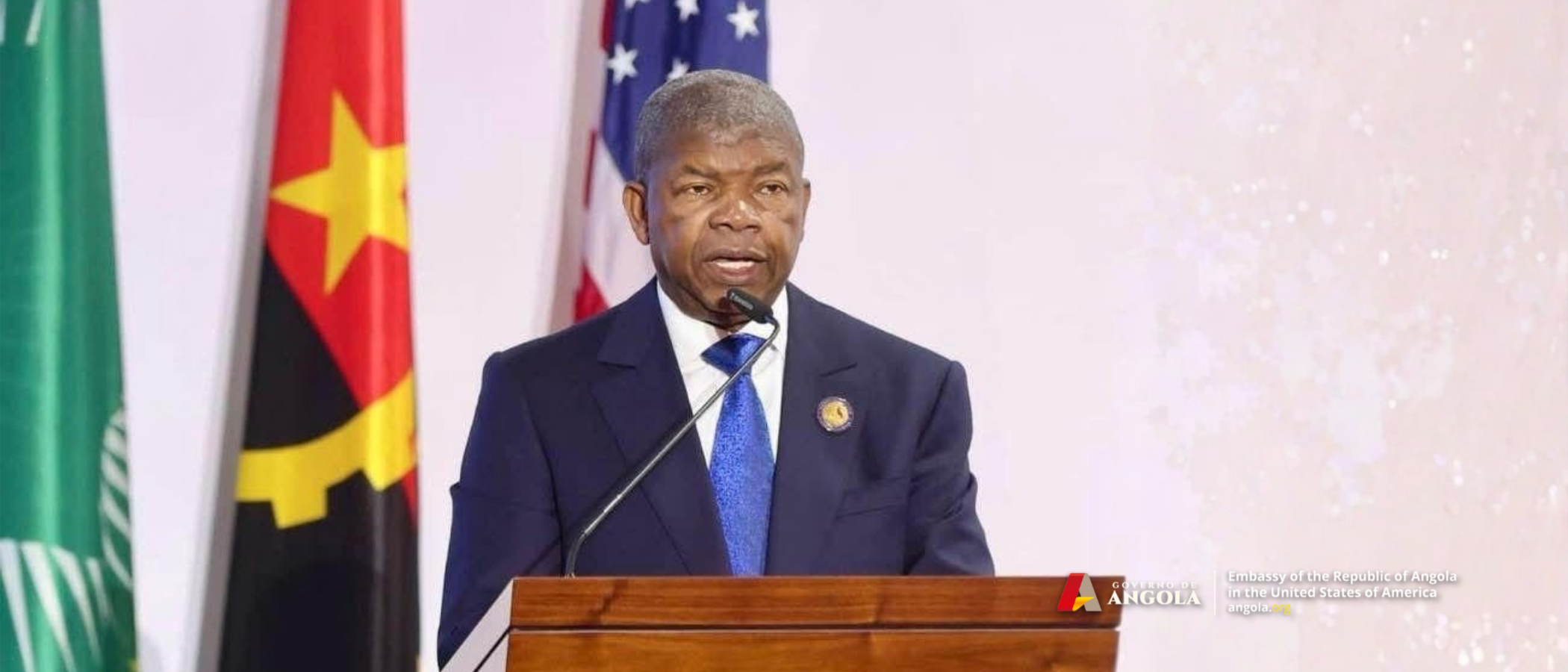
It is a great honour to address you all as the host of this Business Summit, a privileged forum in which we can continue to build an economic paradigm based on a vision of strategic partnership that generates mutual benefits for the development of our nations and peoples, Africa and the United States of America, which are intrinsically linked by a shared historical past.
Today, more than ever, the African continent is positioning itself as one of the major engines of global growth, with a young, innovative and active population, abundant natural resources, and increasingly integrated markets. Africa stands out as a privileged destination for investment and growth opportunities.
Over the past decade, we have witnessed profound economic transformations across several regions of Africa.
Structural reforms have been implemented to make our countries more attractive to investment, with a focus on transparency, regional integration, macroeconomic stability, and the diversification of our economies.
What is happening in countries such as Angola, where the economy returned to consistent growth at a rate of 3.5% in the first quarter of this year, reflects a broader trend across the continent, demonstrating the resilience and economic dynamism of our countries.
However, to fully unlock our potential, we must further intensify and accelerate the ongoing processes of continental economic integration.
We need more functional logistics corridors and common rules that facilitate the movement of capital, goods and people.
Strengthening the African Continental Free Trade Area is therefore a strategic priority and represents an extraordinary opportunity for sharing infrastructure, knowledge and markets, while attracting investment.
To make this a reality and ensure Africa’s economic and social development, the continent has been striving to secure fairer and more favourable financing and credit conditions from international financial institutions such as the World Bank, the International Monetary Fund, other similar institutions and the banking sector, in order to support the necessary public investment in road, railway and port infrastructure, energy, water, and information and communications technologies.
Ladies and Gentlemen,
Economic ties between Africa and the United States of America have significant potential for growth.
Opportunities for foreign direct investment exist in key areas that correspond both to the continent’s priorities and to the comparative advantages of American companies. Among these, we highlight renewable energy, agribusiness and food security, given the availability of millions of hectares of arable land, abundant water resources, favourable climatic conditions, a large young workforce, and a growing need for technological modernisation and digital technologies, where African innovation can combine with American investment capacity to create scalable solutions.
We also highlight strategic minerals, including critical minerals required for the global energy transition, whose responsible exploitation can transform our economies and societies.
In this regard, we expect more than capital. We seek partnerships that respect the sovereignty of our countries, promote local content, facilitate knowledge transfer, and contribute to the creation of skilled jobs.
Excellencies,
Ladies and Gentlemen,
This Forum should be regarded as an important component of economic relations between Africa and the United States of America.
Africa is no longer merely a continent with vast potential in mineral wealth, water and forest resources, and unparalleled demographic growth. It is increasingly a continent of transformative decisions and concrete projects.
We intend, and are working, to electrify and consequently industrialise our countries, adding value to our raw materials and increasing employment opportunities in order to prevent the exodus of our young people—our greatest asset—who undertake the dangerous and humiliating journey across the Mediterranean towards Europe and other destinations in search of employment and better living conditions.
From North to South and from the Atlantic to the Indian Ocean, major infrastructure investments are multiplying and shaping a new African economic landscape. These range from the Lobito Corridor, which will connect the Port of Lobito on the Atlantic Ocean by rail to the Port of Dar es Salaam on the Indian Ocean and promises to transform intra-African and intercontinental trade, to expanding special economic zones across the continent and ongoing initiatives to develop regional value chains in sectors such as critical minerals, agriculture and energy, to name just a few.
At the same time, the digital transformation of the African continent is advancing rapidly. Start-ups and technology platforms are emerging every day, driven by a creative and resilient youth who see digital technologies as a pathway to inclusion, entrepreneurship and employment.
With more than 70% of Africa’s population under the age of 30, it is no exaggeration to say that the future of global innovation will also bear an African imprint, something that is already happening to a certain extent.
In a world marked by persistent geopolitical instability, from Eastern Europe to the Middle East, the African continent, despite some localised pockets of armed conflict or political tension, is establishing itself as a partner for stability and long-term vision.
External circumstances further reinforce the urgency of deepening our ties of trust, economic cooperation and strategic security, in which the role of the United States of America is indispensable, given its unique position on the global stage.
Over the past decades, the American presence in Africa has evolved from one characterised primarily by assistance to one increasingly focused on private investment, innovation and the development of robust partnerships.
However, we would like American foreign direct investment on our continent not to be limited solely to the extraction of conventional and rare mineral resources or to the oil and gas energy sector. We would also like to see greater interest in other manufacturing industries, including iron and steel, aluminium, cement, agriculture and livestock, shipbuilding, the automotive industry and tourism.
American companies currently operating in Africa, including in Angola, are finding an increasingly open business environment that protects foreign private investors, with governments committed to facilitating investment, reducing bureaucracy and creating the conditions for the private sector to lead the economy.
For the American business community, Africa is ready. Our governments are prepared to act as facilitators, and our private sector is available to build partnerships that generate profits while also creating shared prosperity.
**Ladies and Gentlemen,**
These new dynamics make it clear that the time has come to replace the logic of aid with the logic of ambition and private investment. It is time to view Africa as a credible partner with much to offer, but which requires financial capital and know-how and is interested in combining synergies for mutual benefit.
The United States of America, which was never involved in the colonisation of African countries, should adopt a different and unencumbered vision of the continent and, therefore, recognise that Africa’s development, with your contribution, will be beneficial to America and to the world.
If we join forces, together we hold the key to addressing the two major crises that negatively affect the global economy: the food crisis and the energy crisis.
Once again, welcome to you all. Enjoy the beauty of our capital city, Luanda, and the generosity and hospitality of the Angolan people. Experience our music, dance, cuisine and unique natural landscapes.
Make yourselves at home!
With these words, I hereby declare the the U.S.-Africa Business Summit open.
Thank you very much.