

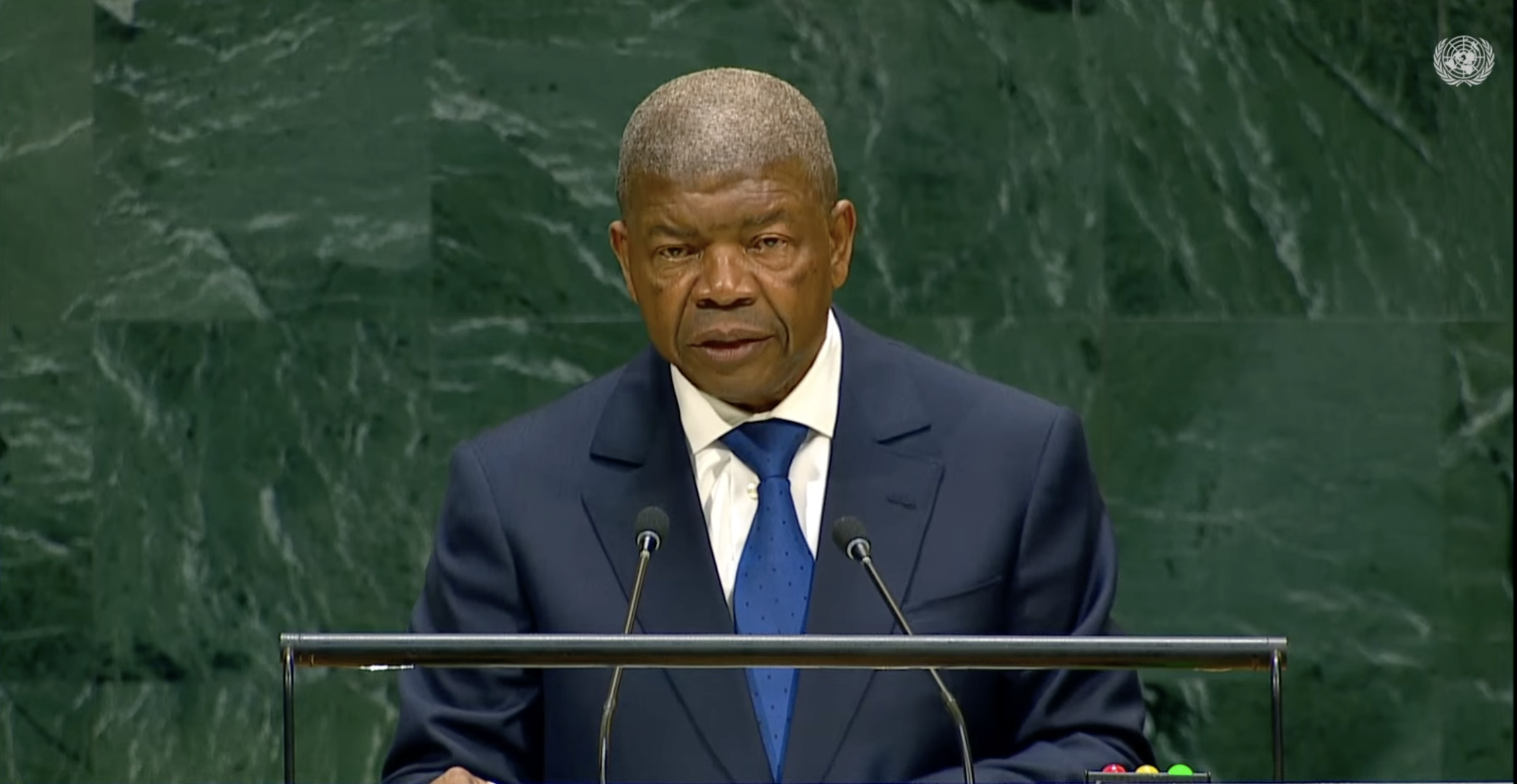
The President of the Republic, João Lourenço, called for strengthening the United Nations’ central role in addressing the complex challenges facing contemporary international relations during the 81st Session of the United Nations General Assembly.
His Excellency António Guterres, Secretary-General of the United Nations,
His Excellency Khalilur Rahman, President of the 81st Session of the United Nations General Assembly,
Your Excellencies, Heads of State and Government,
Distinguished Delegates,
Ladies and Gentlemen,
Allow me to congratulate His Excellency Khalilur Rahman on his election as President of the Eighty-First Session of the United Nations General Assembly, in the hope that, with his extensive experience and profound knowledge of our international organisation, he will render valuable service to the United Nations, which faces complex challenges that must be overcome if it is to reassume its central role in addressing the major issues of contemporary international relations.
I also congratulate Ms. Annalena Baerbock, who preceded him in these noble duties and spared no effort during the mandate she carried out with undeniable competence to preserve the role of the United Nations in addressing the issues of greatest concern to the international community today.
I would also like to congratulate His Excellency Secretary-General António Guterres, who has worked tirelessly and devoted himself with unwavering dedication to the great causes of our time, building bridges for dialogue in the search for peaceful solutions to the challenges facing humanity today.
We particularly acknowledge his exemplary contribution as a man of dialogue, a defender of the Charter of the United Nations and International Law, a tireless advocate of the need to protect the planet from the harmful effects of climate change, and a pioneer of the global debate on the governance of Artificial Intelligence.
Mr. President,
Your Excellencies,
The United Nations General Assembly always takes place in September. This year’s session, however, is being held 25 years after the terrorist attacks that destroyed the Twin Towers in New York and struck other targets on American soil, causing thousands of civilian deaths and injuries, some of whose victims continue to bear the physical and emotional scars to this day.
We take this opportunity once again to condemn terrorism in all its forms, wherever it occurs.
In addition to terrorism, which remains active in some countries, particularly in Africa, the global peace and security situation has continued to deteriorate year after year, to the point where we now observe, with profound concern, that the world has taken a path that is bringing it alarmingly close to a global conflagration.
Over the years, Angola has sought to make its contribution to building and consolidating peace in Africa and throughout the world. However, the current situation does not in any way reflect the aspirations of peoples for harmony and understanding among nations.
Among these contributions to peace are several initiatives undertaken in Africa, of which I would highlight the 21st Extraordinary Conference of the African Union on Strengthening Conflict Prevention and Resolution Mechanisms in Africa, recently held in Luanda, which opened a serious and promising perspective for resolving the challenges affecting peace and stability on the African continent.
Particular attention should also be given to the Third Edition of the “Call for Peace, an End to Wars and Respect for International Law” Initiative, held in Luanda in July this year in partnership with the United Nations Alliance of Civilizations.
Within this same context, Angola will host the Pan-African Forum for the Culture of Peace and Non-Violence — Luanda Biennale next October.
My country takes seriously its commitment to matters relating to peace, the resolution of conflicts through dialogue, respect for the rules governing international relations and the defence of International Law. Angola spares no effort in bringing conflicting parties closer together and building consensus in Africa.
We remain available to devote our attention and contribute to resolving the conflicts that persist on the continent.
Our approach to peacebuilding initiatives is based on the pursuit of realistic and sustainable solutions, guided by the principle of African solutions to African conflicts.
We call for the effective implementation of United Nations Security Council Resolution 2719, which should ensure predictable, adequate and sustainable financing for African Union-led peace support operations authorised by the United Nations Security Council, because investing in Africa’s capacity to prevent and resolve conflicts is also an investment in international peace and security.
Your Excellencies,
Ladies and Gentlemen,
This session of the General Assembly holds particular significance for my country, as it is taking place in the year in which we celebrate the 50th anniversary of the admission of the Republic of Angola as a full member of the United Nations, which occurred in December 1976.
At the time, this represented a historic achievement for the Angolan people, who had waited more than twelve months after the proclamation of National Independence for the country to be admitted as a fully recognised member of the international community.
This event of great significance in the history of my country took place within a global context in which Angola became a victim of confrontation among world powers competing for control over spheres of influence during the Cold War.
Our entire journey towards achieving peace in 2002 was closely linked to the disputes of that era, which constrained the fulfilment of the dreams of the Angolan people and their plans to build a prosperous nation committed to its development.
These events belong to the past, but they left us with a wealth of experience and lessons that we have used to build peace, understanding and reconciliation among all Angolans and to shape the direction of our foreign policy.
The consolidation of peace and national reconciliation is now a reality, as demonstrated by concrete gestures, including ceremonies honouring the principal political leaders of the national liberation struggle and representatives of all sectors of civil society, within the framework of the 50th anniversary of National Independence.
Also within this framework, a monument in memory of all the victims of the political conflicts that occurred in Angola from the proclamation of National Independence until the achievement of peace in April 2002 will be inaugurated in Luanda next October.
Mr. President,
Your Excellencies,
Today, we are witnessing the marginalisation and violation of the rules governing international relations, with the logic of force, intimidation and the imposition of values arising from the unilateral vision of certain countries in defence of their exclusive interests increasingly prevailing.
The instability affecting various regions of our planet is a direct consequence of this approach, as can be observed in the conflicts currently unfolding in Europe, the Middle East, the Persian Gulf and Africa, while tensions continue to rise in the Asia-Pacific region.
Based on what we have observed, we see no encouraging signs regarding the prospect of reaching peace agreements in the near future in the war between Russia and Ukraine, the Israeli-Palestinian conflict in the Middle East, and the conflict in the Persian Gulf.
We condemn genocide against defenceless populations — the elderly, women, children, bedridden patients, healthcare professionals, journalists and workers of international humanitarian organisations — who are often deprived of access to the most basic human rights and essential necessities of life, such as water, food and medicine.
The displacement of Palestinians from their homes and lands through the expansion of Israeli settlements in the West Bank deserves the strongest international rejection and condemnation.
Attempts to dominate countries and entire regions of the world through force of arms are leading the world towards catastrophe.
The food, energy and humanitarian security situation of countries and of the world in general has deteriorated considerably since the outbreak of the war in Ukraine and, more recently, the war against Iran.
The consequences of these wars have been disastrous, particularly given the restrictions on freedom of maritime navigation through the Strait of Hormuz and the Bab el-Mandeb Strait. This situation has created a serious risk of disruption to global supply chains, particularly food and energy supply chains, with devastating consequences for the most vulnerable countries.
Today, we live in an environment of global disorder in which the use of force prevails over the force of reason and law, in blatant opposition to the rules governing international relations.
In light of this situation, there is a pressing need for profound reflection within the United Nations, the only institution on the planet with universal legitimacy and which brings together all the nations of the world, in order to identify the best solutions for achieving global peace.
Our appeal is that we act with wisdom and courage to restore the central role of the United Nations in fulfilling its responsibility and irreplaceable role in maintaining world peace.
Ladies and Gentlemen,
We are concerned by the unjust treatment and profound lack of human sensitivity that Cuba has endured for decades as a result of an embargo that continues to worsen the living conditions of the Cuban people.
Cuba is not a terrorist State. It neither produces nor possesses nuclear, chemical or biological weapons that could constitute an imminent or real threat to the national security of other countries, including its neighbours.
On the contrary, Cuba contributed to the fall of South Africa’s racist and segregationist Apartheid regime, a regime widely and unanimously condemned by the international community, and consequently became one of the signatories of the New York Accords of December 22, 1988.
Given that the embargo is primarily responsible for the extremely difficult situation faced by Cuba and the Cuban people, and because it is inhumane, unjust and contrary to the principles and norms of International Law, we once again call for an end to the embargo against Cuba.
Ladies and Gentlemen,
Today, we are witnessing the direct involvement of some permanent members of the United Nations Security Council in some of the bloodiest and most destructive conflicts currently taking place in Europe and the Persian Gulf. This is a matter of concern and sets a poor example for the rest of the world.
These countries rendered a great service when they freed humanity from the horrors of Nazism, Fascism and the Holocaust, and they should therefore preserve this legacy and their historic role as liberators.
At a time when good governance within countries is widely advocated, global governance also requires a new world order that is more democratic and just, and which is not based solely on the power of the restricted club of victors of a war that took place eight decades ago.
Since then, the world has changed considerably. New countries have emerged that were colonies at the time and are today strong economies with significant advances in science and technology.
It is therefore becoming increasingly pressing and urgent to undertake a profound reform of the United Nations Security Council, in which Africa, Latin America and Asia should be adequately represented as permanent members with all the powers inherent in that status.
In this context, the Republic of Angola reaffirms its full support for the African Common Position enshrined in the Ezulwini Consensus and the Sirte Declaration
.
The voice of Africans must be heard under all circumstances and at all times in strategic decision-making processes concerning peace, global security, development financing, climate issues and the global governance of Artificial Intelligence.
Mr. President,
Your Excellencies,
Peace and development are inseparable, which requires us to consider strategies capable of accelerating the implementation of the 2030 Agenda.
The important decisions taken within the framework of the Pact for the Future and the Seville Commitment can help advance development programmes in Africa.
However, to achieve tangible results in this area, it is essential to ensure access to affordable financing, debt relief, technology transfer, capacity-building and greater participation in international financial institutions.
African countries spend far more resources on the exorbitant costs of debt servicing than they are able to invest in health, education and infrastructure programmes.
This situation clearly limits productive investment, deepens inequalities and economic disparities, and threatens economic and social stability.
In light of this, these distortions must be corrected. I therefore reiterate the call for the immediate reform of the international financial architecture to make it fairer, more equitable, democratic and oriented towards the progress and well-being of humanity.
These challenges are complex in themselves and are further aggravated by climate change, which has a severe impact on Africa through prolonged and severe droughts, floods, desertification, food insecurity and population displacement.
This situation clearly illustrates the need to establish predictable, accessible and additional climate financing without further increasing the debt burden of developing countries.
Today, peoples and nations have an opportunity to achieve a qualitative leap in their overall living conditions through fair development-support mechanisms and the tools provided by Artificial Intelligence to improve education, healthcare, agriculture, public services, scientific research and economic productivity.
In this regard, I believe that the Global Digital Compact opens new prospects for cooperation to bridge the digital divide, expand digital public infrastructure, promote training and innovation, strengthen cybersecurity and build more inclusive, safe and human-centred governance of Artificial Intelligence.
To this end, I believe there is a need to strengthen North-South, South-South and triangular cooperation so that the digital revolution becomes an instrument of inclusion, sovereignty and development rather than a source of dependency and inequality.
Your Excellencies,
We are approaching the end of the current Secretary-General’s mandate and the selection of his successor, a process of great importance given that the person chosen must possess the independence, integrity, competence and courage required to build consensus, defend the Charter, promote conflict prevention, lead the necessary reforms and seek solutions to address the Organisation’s financial crisis.
The Republic of Angola reaffirms its commitment to the United Nations, convinced that only within this institution will it be possible to safeguard the achievements of recent decades in upholding International Law.
Only within the framework of the United Nations can we advance the search for peaceful solutions to the conflicts affecting the world, within a system in which multilateralism serves as the mechanism that brings together ideas, political will and initiatives conducive to world peace.
We, today’s political leaders and governments, will be judged in the future by our ability to replace confrontation with dialogue, predatory competition with cooperation, exclusion with solidarity, and the force of arms with the force of law.
Only in this way will we build a fairer, more peaceful and inclusive international order capable of guaranteeing the progress and well-being of humanity, leaving no one behind.
No weapon is more powerful than diplomacy, because other weapons are used only to destroy lives, infrastructure, dreams and life projects, while diplomacy is the only weapon capable of uniting, repairing, building and saving lives, peoples, nations and humanity.
For this reason, the United Nations must equip itself with the appropriate tools and means to fulfil the theme of the 81st Session of its General Assembly: “Restoring Trust, Managing Transformation: A United Nations That Delivers for Everyone.”
Thank you very much for your attention.